

Your clients want aerial surveillance around the clock. But traditional drones don’t fly after sunset, and that overnight gap is precisely when most security incidents happen. It’s also where a growing number of security companies are finding their competitive edge.
Dual-sensor drones with thermal and visual cameras now let you extend contracted patrol coverage into the night hours, picking up threats from altitude without putting more boots on the ground. This article breaks down how enterprise drones with night vision actually perform in security operations, which platforms suit the job, and how to package night patrols as a revenue-generating service line.
The Business Case for Night Patrols
Private security clients across South Africa, whether they’re running residential estates, commercial parks, farms, or industrial sites, are starting to treat aerial surveillance as table stakes. And fair enough. A drone covers ground faster than a foot patrol and feeds live footage straight to the control room.
The problem? Most operators are limited to daylight. Between dusk and dawn, you’re back to relying on static CCTV and guard rotations. That’s a large window of exposure, and it’s the window when break-ins, stock theft, and illegal access peak.
If your company can fill that gap with genuine thermal drone patrols, you’re not just offering a better service. You’re offering something most of your competitors can’t match yet.
What Dual-Sensor Cameras Actually Do at Night
Two sensors do the heavy lifting here: a thermal imager and a standard visual (RGB) camera. They serve different purposes, and it’s the combination that makes night patrols work.
The thermal sensor reads heat. People, vehicles, animals — anything warmer than its surroundings shows up clearly, regardless of lighting. Pitch black, dense fog, light smoke. Doesn’t matter. An operator can pick up someone moving along an unlit fence line from hundreds of metres out, based purely on body heat. No spotlight needed, no alert given to the intruder.
The visual camera, meanwhile, delivers high-resolution imagery with serious zoom range. In twilight conditions or partially lit areas, it captures footage sharp enough for identification and evidence. Where it gets really useful is the split-screen mode: thermal on one side flagging a heat signature, visual on the other zooming in for confirmation. Is it a person or a kudu? You’ll know in seconds.
Two Platforms Worth Looking At
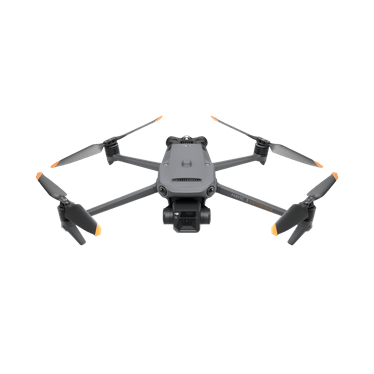
Not every enterprise drone handles night security equally. Two in the DJI Mavic 3 Enterprise range stand out for this kind of work.
DJI Mavic 3 Enterprise Thermal (M3T)
TheDJI Mavic 3 Enterprise Thermal carries a 48 MP wide-angle camera, a 640 x 512 thermal sensor, and a 12 MP telephoto with 56x hybrid zoom. It folds small enough to hold in one hand and gets airborne in seconds. Flight time tops out at 45 minutes per battery.
What makes it practical for security work is the 28x continuous side-by-side zoom across thermal and visual feeds. Your operator can compare a heat alert against zoomed-in visual detail in real time, confirming or dismissing threats without repositioning the drone. Omnidirectional obstacle sensing and APAS 5.0 keep the aircraft safe during low-altitude sweeps around buildings, fences, and tree lines, which matters when you’re flying in the dark.
DJI Mavic 3 Thermal Advanced (M3TA)
The DJI Mavic 3TA takes the same airframe and upgrades the thermal optics. The lens narrows to a 41.2-degree field of view with an 8 micrometre pixel pitch, down from the M3T’s 12 micrometres. Sounds incremental on paper, but the difference on screen is significant: sharper thermal resolution at longer ranges, which lets operators identify heat sources from higher altitudes and greater standoff distances.
Same 48 MP wide camera. Same 56x zoom telephoto. Same grab-and-go size. For security contracts covering large estates, multi-building commercial sites, or scattered rural properties, that extra thermal reach changes the quality of what you’re able to report back to the client.
Building the Service Around the Technology
Buying a thermal drone doesn’t automatically give you a night patrol service. You need structure around it, or the offering falls flat.
Route planning comes first. Sit down with the client, map their property, and mark the vulnerable points: access roads, fence lines with poor CCTV coverage, equipment yards, livestock camps. Design repeatable waypoint missions that cover those areas in sequence. Automated routes keep patrols consistent and efficient.
Then work out how the drone fits your existing team. It shouldn’t replace ground guards; it should make them more effective. One model that works well: scheduled perimeter sweeps every 60 to 90 minutes, plus on-demand launches when an alarm trips or the control room spots something. The drone provides the overhead view. Your ground team handles the physical response.
Batteries are the logistical piece. At up to 45 minutes per flight and fast charging through the 100 W hub, three or four batteries in rotation keep gaps between sorties short. Not zero, but manageable.
Staying on the Right Side of Regulations
Commercial drone operations in South Africa fall under the South African Civil Aviation Authority (SACAA), and night flying carries specific requirements. Your pilots need the appropriate remote pilot licence with a night rating, and your Remote Operator Certificate (ROC) must explicitly cover after-dark operations. Getting this right protects your business, reassures your clients, and frankly separates you from operators cutting corners.
Turning Night Patrols into Recurring Revenue
Thermal night capability is a premium add-on, and clients understand that. The ability to detect and confirm threats across an entire property in total darkness, all from altitude, is something static cameras and foot patrols simply can’t replicate.
A tiered pricing structure works well here. Offer scheduled patrols at fixed intervals as a base package. Add reactive deployment, where the drone launches in response to alarm activations, as a mid-tier option. Full 24-hour continuous aerial coverage sits at the top for high-value clients with the budget and the risk profile to justify it. Each tier drives recurring monthly revenue from your drone investment.
Frequently Asked Questions
Can thermal drones really see in complete darkness?
They can. Thermal sensors pick up infrared radiation, which is heat, not light. A person walking across an open field at 2 a.m. with no moon and no streetlights will show up clearly on the thermal feed.
How far away can a thermal drone identify a person?
Detection range depends on the platform and conditions. The M3TA’s tighter thermal lens picks up heat signatures at longer distances than the standard M3T, and the 56x hybrid zoom on the visual camera lets you close in for identification without moving the drone closer.
Do I need special licensing for night operations?
Yes. SACAA requires a night rating on your remote pilot licence and explicit night-flying approval on your ROC. Don’t skip this step. It’s a legal requirement and a liability issue.
How many batteries do I need for overnight coverage?
Three to four, rotated through the 100 W charging hub. One flies, the others charge. You’ll have short changeover gaps, but continuous coverage through the night is achievable.
Will drones replace my ground security guards?
No, and that’s not the pitch. Drones are a force multiplier. They extend your surveillance footprint and give your control room live intelligence. Your ground team still handles the physical response. Together, the two are substantially more effective than either one alone.
Conclusion
For private security companies in South Africa, night-time aerial patrols are one of the clearest growth opportunities on the table right now. The DJI Mavic 3 Enterprise Thermal and the Mavic 3TA put genuine thermal detection capability into a compact, field-ready package, letting your teams spot and confirm threats in total darkness.The companies investing in this capability now are the ones signing the contracts their competitors can’t service. Contact Afri Air to talk through the right setup for your operation.


