
Reading Time: 3 minutes
Key Takeaways
- The T70P carries 70 L of spray and 100 L of granules. The T100 carries 100 L and 150 L.
- The T70P lifts up to 65 kg. The T100 lifts up to 100 kg.
- Aircraft weight is 56 kg for the T70P and 75 kg for the T100, so the T100 needs more handling and transport capacity.
- Both share the DB2160 battery, D14000iE generator, C12000 charger and TKPL 2 remote controller.
- Both spray at 30 L/min as standard and 40 L/min with the optional four-nozzle setup.
Agricultural Spray Technology for Modern Farming
South African agriculture faces ongoing pressure to increase productivity whilst managing input costs and environmental responsibilities. Agricultural drone technology addresses these challenges by delivering precise chemical application that reduces waste, improves coverage consistency, and adapts to varied terrain conditions.
Explore the DJI Agras T70P’s complete specifications and capabilities to understand how precision spray technology becomes practically accessible for farming operations. Understanding which system suits your specific field layouts ensures optimal investment decisions.
| Specification | DJI Agras T70P | DJI Agras T100 |
|---|---|---|
| Aircraft weight | 56 kg (with DB2160 battery) | 75 kg (spraying, 2 nozzles) |
| Max takeoff weight, spraying (2 nozzles) | 126 kg (DB2160 battery) | 175 kg |
| Spray tank | 70 L (70 kg payload) | 100 L (100 kg payload) |
| Max flow rate | 30 L/min standard (2 nozzles); 40 L/min optional (4 nozzles) | 30 L/min standard (2 nozzles); 40 L/min optional (4 nozzles) |
| Effective spray width | 4 to 11 m | 5 to 13 m |
| Droplet size | 50 to 500 µm | 50 to 500 µm |
| Spreader hopper | 100 L (70 kg max load) | 150 L (100 kg max load) |
| Max spreading rate | 400 kg/min | 400 kg/min |
| Effective spreading width | 3 to 10 m | 3 to 10 m |
| Lift capacity | 65 kg | 100 kg (80 kg with dual-battery lifting system) |
| Obstacle sensing | Millimetre-wave radar + tri-eye vision | LiDAR + millimetre-wave radar + quad vision system + FPV camera |
| Sensing range | Up to 60 m | Up to 60 m |
| Effective safe obstacle-avoidance speed | Up to 13.8 m/s | Up to 13.8 m/s |
| Max wind resistance | Below 6 m/s | Below 6 m/s |
| Operating temperature | 0 °C to 40 °C | 0 °C to 40 °C |
| Flight battery | DB2160 (41,000 mAh); also DB1580 (30,000 mAh) | DB2160 (41,000 mAh) |
| Recharge, 30% to 95% (DB2160) | 8 to 9 minutes | 8 to 9 minutes |
| Size, arms and propellers folded | 1160 × 900 × 960 mm | 1105 × 1265 × 975 mm |
| Remote controller | TKPL 2 | TKPL 2 |
DJI notes that effective spray width depends on the working scene, and that the DJI Agriculture App recommends the actual loading weight for each flight.
Agras T70P vs T100: Understanding the Key Differences
Tank Capacity and Field Configuration
The main difference is capacity: 70 L for the T70P and 100 L for the T100. Both fly on the same DB2160 battery, so a larger tank means more chemical per flight, while frequent turns and high application rates use battery faster. Whether the tank or the battery runs out first depends on your application rate, run length and number of turns.
As a general guide, long, straight fields suit the larger T100 tank, and irregular or smaller fields suit the lighter T70P. Contact Afri Air with your field sizes and we will work through the numbers with you.
Shared Components and Compatibility
Both systems share key parts, which simplifies a mixed fleet:
- Power: Both fly on the DB2160 battery (41,000 mAh, 52 V). The D14000iE generator and C12000 charger recharge it from 30% to 95% in 8 to 9 minutes. The T70P also accepts the smaller DB1580 (30,000 mAh), which is not listed for the T100.
- Control: Both use the TKPL 2 remote controller with a 7-inch screen, so pilots can move between aircraft without retraining on a new controller.
Both drones are modular, with separate spraying, spreading and lifting systems. The T100 also offers dual-battery spraying and lifting systems.
Spray System Specifications
Both aircraft use two magnetic-drive impeller pumps. Flow reaches 30 L/min with the standard two nozzles and 40 L/min with the optional four. Droplet size is adjustable from 50 to 500 µm. Effective spray width is 4 to 11 m on the T70P and 5 to 13 m on the T100, depending on the working scene.
Operational Performance
Both aircraft are rated for winds below 6 m/s and operating temperatures from 0 °C to 40 °C. Their obstacle-avoidance systems work reliably at flight speeds up to 13.8 m/s, and both have a maximum configurable flight radius of 2 km. Always follow chemical label limits on wind speed.
Terrain-Following Technology
South African farmland ranges from level irrigation schemes to rolling highveld and steep vineyard slopes. On both the T70P and T100, downward sensing supports terrain-following flight, which helps keep spray height consistent over undulating ground.
Obstacle Sensing
The two aircraft use different sensing suites. The T70P combines millimetre-wave radar with tri-eye vision. The T100 adds LiDAR and uses a quad vision system with an FPV camera. Both detect obstacles up to 60 m away.
Precision Application Features
Both systems incorporate mapping capabilities that define treatment zones with accuracy, preventing overspray into buffer zones, waterways, or neighbouring properties.
Variable rate application allows operators to adjust spray intensity across different field zones based on agronomic requirements. Spot treatment functionality enables targeted application to problem areas without treating entire fields, substantially reducing chemical costs for localised infestations.
Farm Management Integration
Both platforms integrate with digital farm management systems, creating automatic records of application activities including coverage maps, application rates, chemical usage, and timing data essential for compliance documentation.
Mission planning software allows operators to prepare spray programmes in advance, optimising flight paths for efficiency whilst ensuring complete coverage.
Choosing Between the T70P and T100
Select the Agras T70P when:
- Fields require frequent directional changes
- Farm layout includes irregular field shapes or smaller paddocks
- Operations prioritise maximum battery efficiency through tank-battery synchronisation
- Preference exists for swappable tank design between spreading and spraying tasks

DJI AGRAS T70P
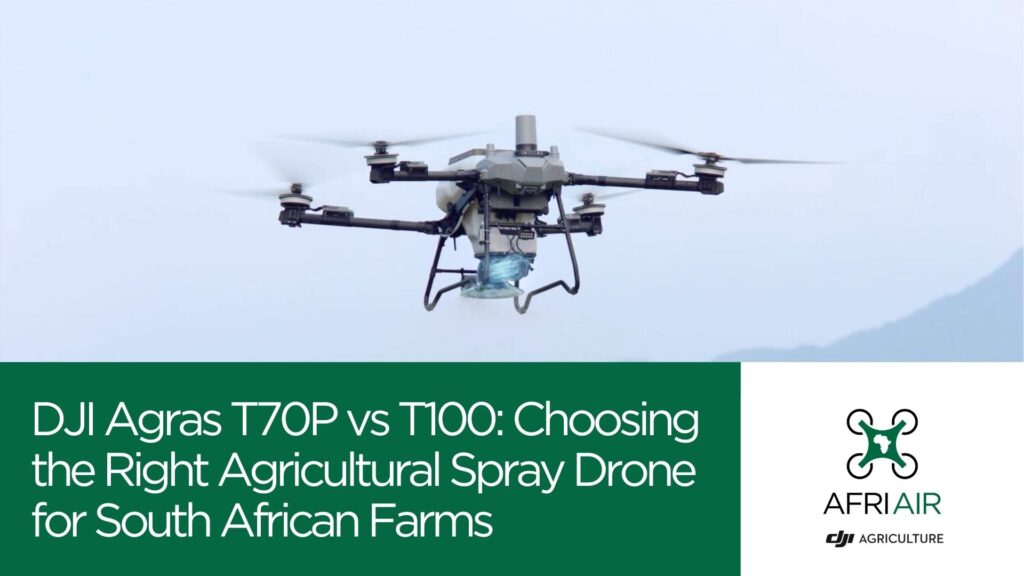
The DJI Agras T70P is a multi-purpose agricultural drone for spraying, spreading and lifting. It has a 70 L spray tank, a 100 L spreader, 65 kg lift capacity, and Safety System 3.0 with millimetre-wave radar and tri-eye vision.
Select the Agras T100 when:
- Fields predominantly feature long, straight configurations
- Farm layout includes extensive linear plantings or large irrigation blocks
- Operations benefit from reduced refill frequency on extended straight runs
- Preference exists for clip-on frame versatility

DJI AGRAS T100
The DJI Agras T100 is built for large-scale spraying, spreading and lifting. It has a 100 L spray tank, a 150 L spreader, 100 kg lift capacity, LiDAR, radar and Penta-Vision sensing, and DB2160 batteries that recharge from 30% to 95% in 8 to 9 minutes.
South African Operating Considerations
Agricultural operations across South Africa encounter diverse environmental conditions. Both systems operate effectively across typical South African temperature ranges, though operators should consider early morning or late afternoon operations during extreme summer heat.
Compliance with South African Civil Aviation Authority regulations remains essential, requiring appropriate licensing and adherence to operational limitations specific to agricultural aerial application.
Frequently Asked Questions
Can I use the same batteries for both systems?
Mostly. Both drones fly on the DB2160 battery (41,000 mAh) and use the same D14000iE generator and C12000 charger. The T70P can also fly the smaller DB1580 (30,000 mAh), which is not listed for the T100.
What training is required to operate these agricultural spray drones?
Operators require both aviation training for drone operation and agricultural knowledge for chemical application. Afri Air provides comprehensive training covering flight operations, spray system management, chemical handling, and regulatory compliance for both platforms.
How does field shape affect which system I should choose?
Field configuration significantly impacts efficiency. The T70P’s 70-litre tank optimises battery usage for fields requiring frequent turns, whilst the T100’s 100-litre capacity suits long, straight fields where turns occur less frequently.
What maintenance do these systems require?
Regular maintenance includes spray system cleaning after each operation, nozzle inspection, motor and propeller checks, and battery care. Both platforms follow similar maintenance procedures, with systematic cleaning preventing chemical buildup affecting performance.
Are the remote controllers the same for both systems?
Yes, both platforms use the same remote controller, reducing training requirements and operational complexity when farms employ multiple systems or transition between platforms.
How does the system prevent chemical drift?
Precision flight control, optimal spray height maintenance through terrain-following radar, and droplet size management minimise drift risk. Operators should follow chemical label requirements and observe weather conditions suitable for aerial application.
Conclusion
The DJI Agras T70P and T100 share a battery, charging and remote controller ecosystem, but they are not interchangeable. The T100 offers a 100 L spray tank, 150 L spreader, 100 kg lift capacity and LiDAR-equipped sensing. The T70P offers 70 L, 100 L and 65 kg in a lighter aircraft.
Field layout matters, and so do your payload needs, transport, and handling. Contact Afri Air’s drone specialists for guidance on which system suits your farming operation.


